How You Play Games

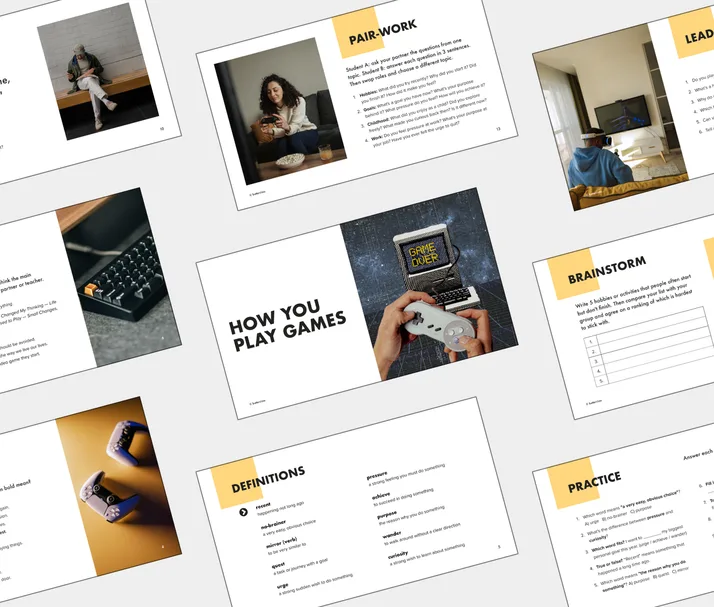
Video games split players into two types fast: the ones who finish everything, and the ones who rack up thirty hours in a week, then quit halfway through and start something new. This B1 lesson turns that second habit into a reading and discussion class about gaming, daily routines, and the goals people chase without really choosing them. Students read a personal essay linking gaming habits to real life, work through vocabulary like urge, quest, and purpose, then compare the story to their own routines. A quote from Fernando Pessoa gives the final discussion an easy way in.
Lesson overview
- Practice vocabulary including urge, quest, mirror, and purpose in real contexts
- Discuss how gaming habits reflect daily routines and personal goals
- Read a personal essay and summarize each section using given keywords
- Build speaking skills through pair work, quotes, and short opinion talks
Inside this lesson:
- Original article
Vocabulary
- recent
- no-brainer
- mirror (verb)
- quest
- urge
- pressure
- achieve
- purpose
- wander
- curiosity
Contents
- Lead-in
- Brainstorm
- Vocabulary
- Definitions
- Discussion
- Article
- Summary
- Quote
- Practice
- Speaking
- Pair-work
- Homework
Start with the lead-in questions on page one. Ask students if they play video games and which hobbies they’ve dropped halfway through. These questions get the room talking before the reading even comes up, and they set up the theme naturally. Move into the brainstorm. Give students two or three minutes to list five hobbies people often quit, then have them compare lists in small groups and agree on a ranking. This works well for B1 classes because it forces students to justify their choices out loud.
Cover the vocabulary before the article, not after. Words like urge, quest, mirror, and purpose show up constantly in the text, so pre-teaching them saves time later. Use the definitions page for quick checking, then move to the discussion activity, where students predict the article’s main message from the title and headings alone. This prediction step gets them reading actively instead of just scanning for answers.
Hand out the article and give students five minutes to read. The summary activity works best right after, since the keywords guide students through each section without needing to reread the whole thing. Once summaries are done, bring the class back together for the Fernando Pessoa quote. Ask if anyone feels that way about a hobby or a job. This usually gets quieter students talking.
Finish with the practice questions to check vocabulary, then move into speaking and pair work. The speaking cards work well in small groups of three, where students take turns guessing what each gaming habit says about the person. For homework, students prepare a short speech recommending a game they enjoyed. Give them the three points to include, and let them present next class.
This lesson was created by
 Oleg
Since 2012, I’ve been teaching English online, connecting with students across Asia and Europe. Over the years, I’ve shifted my focus to corporate English, helping professionals refine their communication skills. My lessons are infused with my interests in tech, global issues, and sports, offering a mix of challenges and engaging discussions.
on Sep 2, 2026.
Oleg
Since 2012, I’ve been teaching English online, connecting with students across Asia and Europe. Over the years, I’ve shifted my focus to corporate English, helping professionals refine their communication skills. My lessons are infused with my interests in tech, global issues, and sports, offering a mix of challenges and engaging discussions.
on Sep 2, 2026.
0 comments
Comments are moderated against a short code of conduct. Disagree as much as you like; do it kindly.