What Happened to Personality?
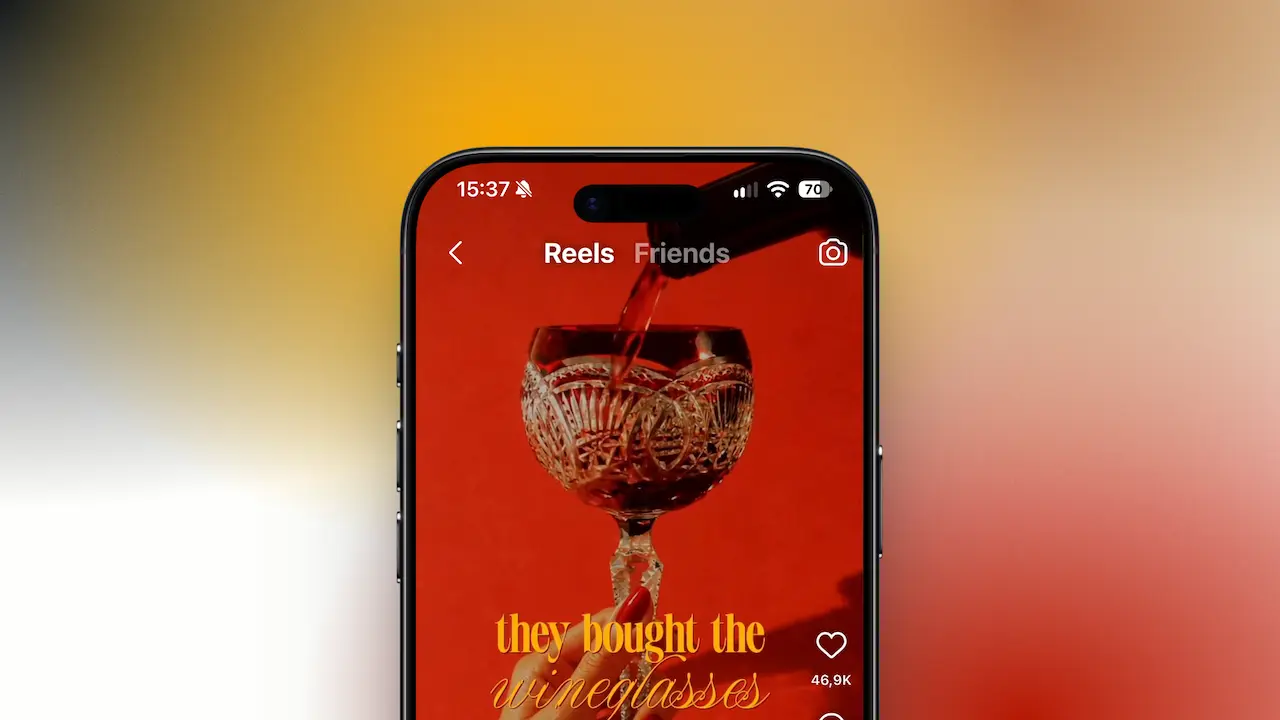
Click the image to watch the video on Instagram
Some people buy a lamp simply because it works. Others buy the one that makes them stop and look twice. This B1 lesson asks students which type they really are, then pushes the question further: why do so many homes, cafes and everyday products end up looking almost identical? Through speaking, vocabulary and a short video, students explore words like unique, soulless, curious and carving while building arguments for both sides of the debate. The final twist, revealed near the end of the lesson, gives the whole topic a new angle.
Lesson overview
- Practice describing objects and explaining what makes them feel personal.
- Learn vocabulary like unique, curious, carving, and soulless in context.
- Discuss minimalism, mass production, and whether design has lost its personality.
- Watch a short video and debate what changes once AI made it.
Inside this lesson:
- 1 video
Vocabulary
- personality
- unique
- curious
- carving
- detail
- by hand
- plain
- soulless
Contents
- Lead-in
- Speaking
- Vocabulary
- Definitions
- Reading
- Video
- True or False
- Summary
- Agree or Disagree
- Practice
- Discussion: Minimalism
- Discussion: Everything Looks the Same
- Discussion: Handmade vs. Mass-Produced
- Extra
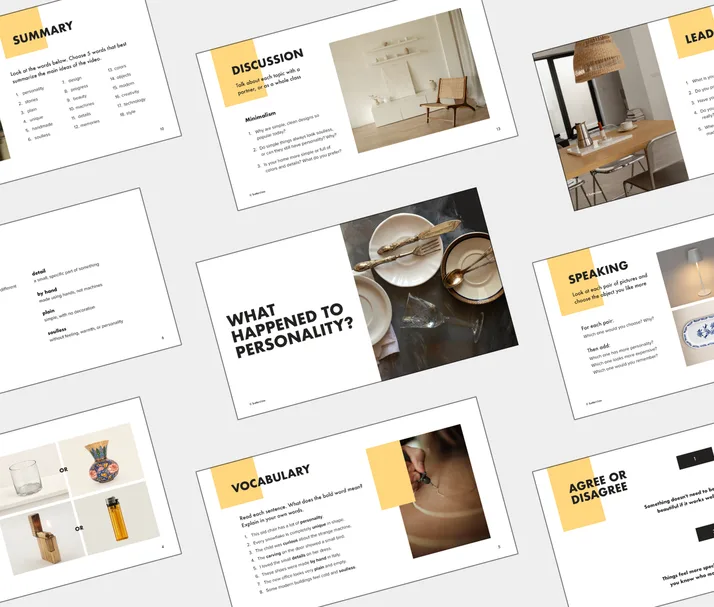
Start this B1 lesson with the lead-in questions on slide one. Ask students to think about their favorite object at home and why it matters to them. This previews the main theme before you move into vocabulary. The speaking activity on slides three and four works well right after, since students compare pairs of objects, like a glass vase and a ceramic one, or a modern lamp and an older, patterned one. Push them to explain their choices out loud, not just pick one.
Move into the vocabulary slide next. Students read each sentence and guess the meaning of the bold word before checking the definitions slide. Words like carving, soulless and by hand come up again later, so spend real time here. The reading passage sets up the video, so give students a minute to find what makes an object special and the change the writer notices in design today. Play the video once or twice before the true or false questions, since some details are easy to miss.
The summary task works well as a quick check before speaking. Ask students to pick five words that capture the video’s main idea, then compare choices as a class. The agree or disagree statements and the practice exercise with personality, unique and soulless give more controlled practice before the open discussions on minimalism, sameness in design, and handmade versus mass produced objects.
Save the extra slide for the end. Once students find out the video itself was made by AI, script and voice included, the conversation gets more interesting fast. Ask if that changes how they feel about a message on personality and soul, and let them disagree with each other. It’s a good way to close a lesson built around exactly this question.
This lesson was created by
 Oleg
Since 2012, I’ve been teaching English online, connecting with students across Asia and Europe. Over the years, I’ve shifted my focus to corporate English, helping professionals refine their communication skills. My lessons are infused with my interests in tech, global issues, and sports, offering a mix of challenges and engaging discussions.
on Sep 20, 2026.
Oleg
Since 2012, I’ve been teaching English online, connecting with students across Asia and Europe. Over the years, I’ve shifted my focus to corporate English, helping professionals refine their communication skills. My lessons are infused with my interests in tech, global issues, and sports, offering a mix of challenges and engaging discussions.
on Sep 20, 2026.
0 comments
Comments are moderated against a short code of conduct. Disagree as much as you like; do it kindly.