Dance & Tradition
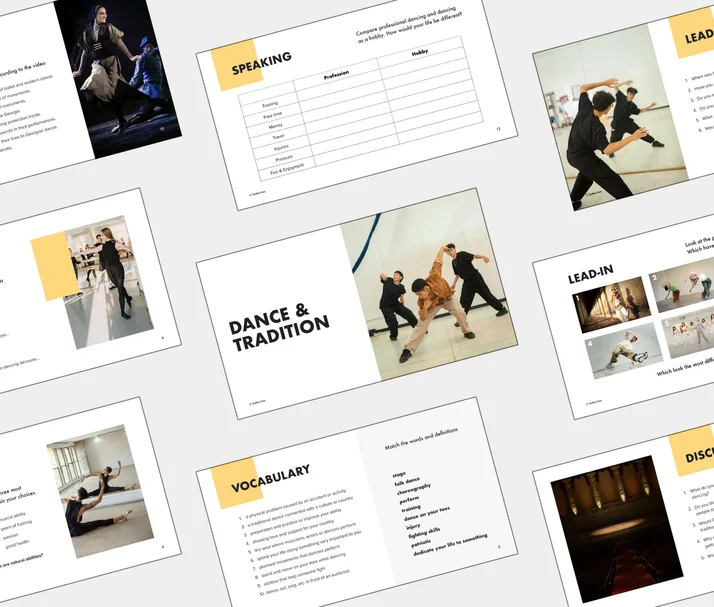
Standing on your toes for two hours sounds painful, and for professional dancers, it often is. This B1 lesson uses a video about a Georgian dance company to look at what that kind of training actually demands from the body and the mind. Students learn words like injury, fighting skills and dedicate your life to something, then practice them through comprehension questions, true or false statements and a rephrasing exercise. Discussion questions and a final speaking task push students to decide whether that level of commitment sounds worth it to them.
Lesson overview
- Learn key dance vocabulary like choreography, injury, training and fighting skills through matching
- Watch a video about a professional Georgian dance company and their intense training
- Practice true or false statements and fill in the blank comprehension tasks from a video
- Discuss the differences between dancing as a professional career and dancing as a hobby
Inside this lesson:
- 1 video
Vocabulary
- stage
- folk dance
- choreography
- perform
- training
- dance on your toes
- injury
- fighting skills
- patriotic
- dedicate your life to something
Contents
- Lead-in
- Speaking
- Vocabulary
- Practice
- Video Preview
- Video
- Comprehension
- True or False
- Discussion
- Practice
- Speaking
- Homework
Start with the lead-in questions on slide one. Ask students when they last danced and whether they think they’re any good at it. These questions work well in pairs or small groups because everyone has an opinion, even reluctant talkers. The picture matching activity that follows gets students naming dance styles they recognize, which is a nice way to check vocabulary before you move into the main topic. Push students past one-word answers when they can, since everyone tends to name the same two or three styles at first.
Before the video, spend time on the vocabulary matching task. Words like choreography, folk dance and dedicate your life to something come up constantly once the video starts, so students need them ready. The speaking activity about what makes a good dancer works well here too. Have students rank strength, flexibility, confidence and the other qualities, then defend their top three choices to a partner.
Play the video Georgian Dancers Push Their Physical Limits for Tradition once for general understanding, then again for the fill in the blank comprehension task. The numbers and details come fast, so a second viewing usually helps. The true or false statements that follow work well as a quick check before moving to discussion questions about tradition, injury and dedication. Georgian dance is a good example because it mixes ballet, folk and modern movement in one performance.
Finish with the rephrasing practice, which forces students to actually use words like injury and fighting skills instead of just recognizing them. The final speaking task, comparing professional dancing to dancing as a hobby, makes a good wrap-up because it pulls together training, money, travel and free time in one conversation. Assign the homework review as a way to keep the topic going after class.
This lesson was created by
 Oksana
Teaching for 10+ years has taken me across cultures, from living in Asia to working with diverse students worldwide. Now, I focus on general and business English for adults, crafting lessons that are engaging, practical, and inspired by my love for travel, photography, and culture.
on Aug 21, 2026.
Oksana
Teaching for 10+ years has taken me across cultures, from living in Asia to working with diverse students worldwide. Now, I focus on general and business English for adults, crafting lessons that are engaging, practical, and inspired by my love for travel, photography, and culture.
on Aug 21, 2026.
0 comments
Comments are moderated against a short code of conduct. Disagree as much as you like; do it kindly.