The Watch Worth Keeping
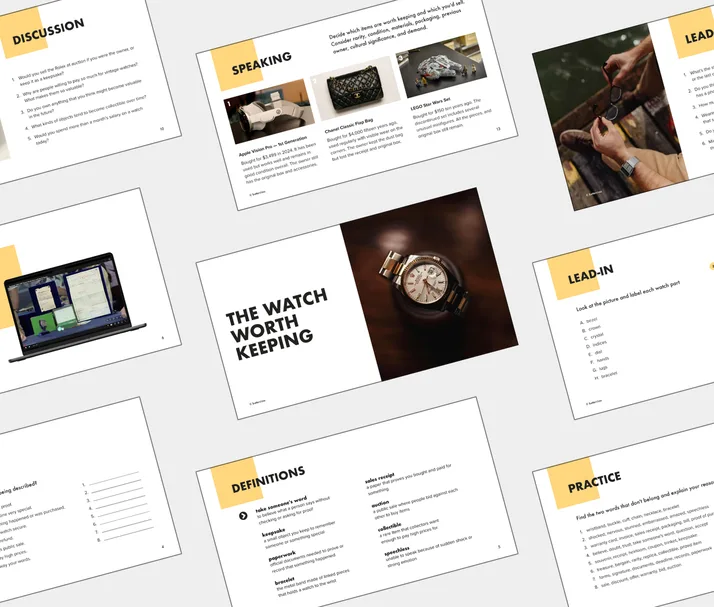
A watch tells the same time whether it cost $30 or $30,000, so why do some people treat theirs like a treasure? This B2 lesson plan is built around a real appraisal video, where a man discovers his old Rolex is worth thousands more than he ever guessed. Students pick up watch vocabulary like auction, keepsake, and collectible before watching the interview and answering detailed questions. A reading passage on what makes items valuable leads into two speaking tasks comparing modern collectibles, from sneakers to designer bags. The lesson works because every student has an opinion about what’s actually worth keeping.
Lesson overview
- Learn key watch and collectible vocabulary like auction, keepsake, and paperwork
- Watch a real appraisal video and answer detailed listening comprehension questions
- Discuss what makes old items valuable using a structured reading passage
- Practice speaking skills by deciding which collectible items are worth keeping
Inside this lesson:
- 1 video
Vocabulary
- take someone’s word
- keepsake
- paperwork
- bracelet
- sales receipt
- auction
- collectible
- speechless
Contents
- Lead-in
- Vocabulary
- Definitions
- Video
- Questions
- Summary
- Discussion
- Practice
- Reading
- Speaking
Start class with the lead-in questions. Ask students about the story behind their own watch, or whether a watch is even necessary now that everyone checks their phone for the time. These questions work well as a quick pair discussion before you move into the watch vocabulary. The picture labeling task, with parts like bezel, crown, crystal, and indices, also gets students noticing details on a watch they’ve probably never had to describe in English before.
Once students match the vocabulary clues to the correct definitions, including auction, keepsake, paperwork, and sales receipt, move into the video. Play the appraisal clip once for general understanding, then a second time so students can answer the five comprehension questions in order. The summary fill-in-the-blank exercise makes a strong final check after both viewings, since it forces students to recall specific numbers and details, like the price paid and the final valuation.
The discussion questions push students past the video itself. Ask whether they’d sell a similar watch at auction or keep it as a keepsake, and why people pay so much for vintage items in the first place. The odd-one-out practice activity reinforces the new vocabulary in a lower-pressure format before students move into the reading passage, which lays out five factors that affect an item’s value: rarity, condition, materials, previous owner, and demand.
Finish with the two speaking activities. Give each group the six items, from a used Chanel bag to an unopened Labubu figure, and have them decide what’s worth keeping and what they’d sell, using the reading’s five factors as their reasoning. Newer teachers should let this run a little long. B2 students usually have strong, specific opinions about which collectibles actually hold their value over time.
This lesson was created by
 Oleg
Since 2012, I’ve been teaching English online, connecting with students across Asia and Europe. Over the years, I’ve shifted my focus to corporate English, helping professionals refine their communication skills. My lessons are infused with my interests in tech, global issues, and sports, offering a mix of challenges and engaging discussions.
on Aug 15, 2026.
Oleg
Since 2012, I’ve been teaching English online, connecting with students across Asia and Europe. Over the years, I’ve shifted my focus to corporate English, helping professionals refine their communication skills. My lessons are infused with my interests in tech, global issues, and sports, offering a mix of challenges and engaging discussions.
on Aug 15, 2026.
0 comments
Comments are moderated against a short code of conduct. Disagree as much as you like; do it kindly.